
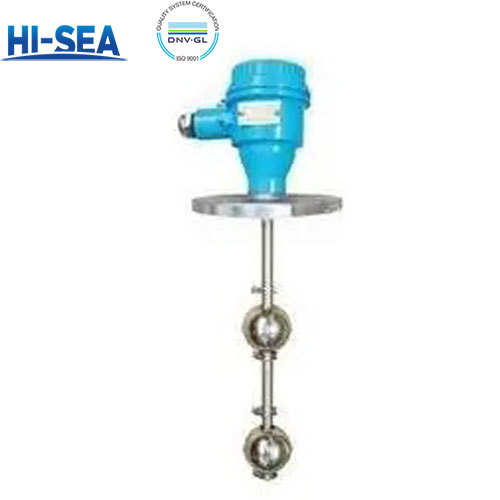
Top Mounted Level Transmitter
A Top Mounted Level Transmitter (also known as a Top-Down or Submersible Level Transmitter) is an electronic device used to measure the level of a liquid in a tank, well, or other container. As the name implies, it is installed from the top of the vessel and extends down into the liquid.
Overview
How Does It Work? The Core Principle
The operation is based on a simple physics formula:
Pressure (P) = Density (ρ) × Gravitational Acceleration (g) × Height (h) of Liquid
• The transmitter has a sensing element (a diaphragm) at its tip.
• This diaphragm detects the pressure created by the weight of the liquid above it.
• The transmitter's internal electronics convert this measured pressure into a level reading.
• To account for atmospheric pressure changes (which would affect the reading), most transmitters are vented. A small capillary tube inside the cable allows the internal reference side of the sensor to equalize with the atmosphere. If the vessel is pressurized, a sealed or gaugereference is used.
Key Advantages
• Simple Installation & Maintenance: No need to drill holes in the side of the tank. Installation and removal can often be done without emptying the tank.
• No Moving Parts: Highly reliable, minimal wear and tear, and reduced maintenance.
• Suitable for Deep Applications: Ideal for measuring levels in very deep tanks or wells (e.g., hundreds of meters).
• Versatile: Can be used in a wide range of liquids, including water, wastewater, oils, fuels, and some chemicals (with compatible wetted materials).
• Cost-Effective: Generally less expensive than radar or ultrasonic transmitters, especially for simple applications.