
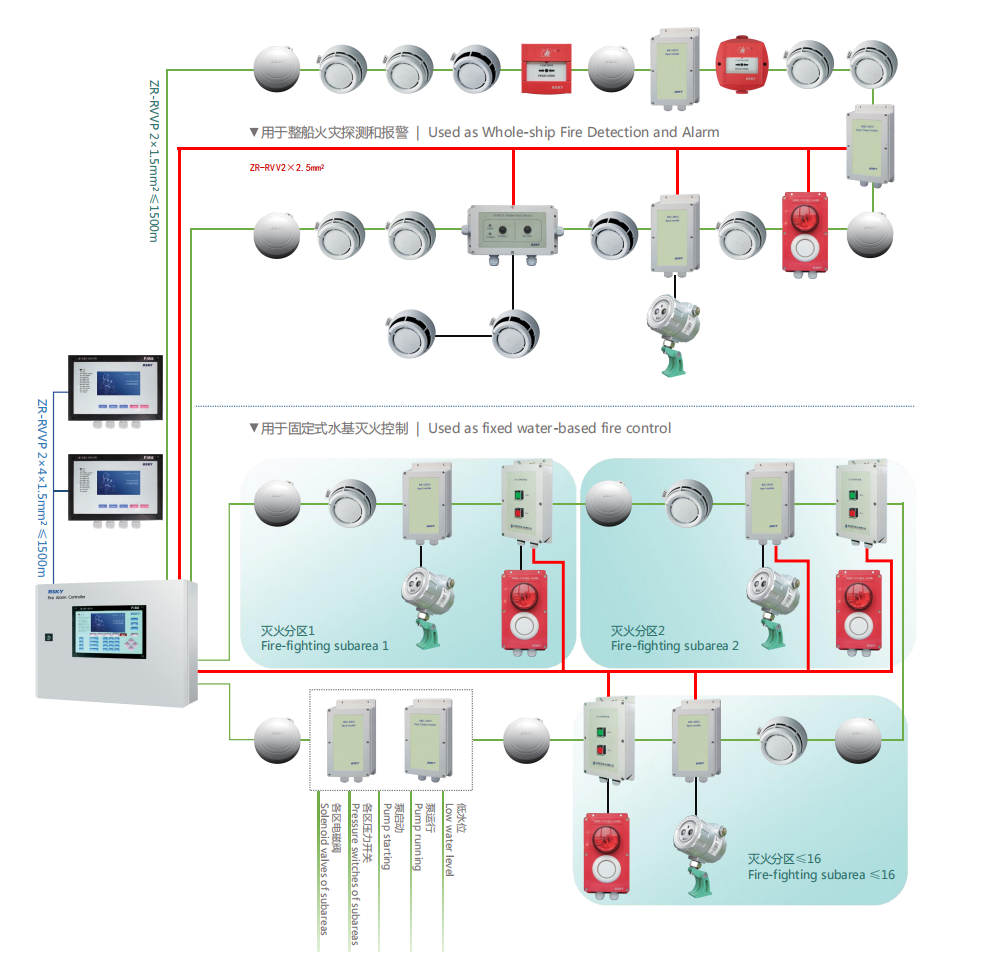

Understanding Marine Fixed Fire Detection and Fire Alarm System
The primary goal of modern fire protection is early detection before a fire can spread uncontrollably, enabling timely and appropriate response. Early detection facilitates fire control before it escalates to a point endangering life and property.
Fire detection and alarm systems must be operational at all times, with power continuously supplied, and constantly monitored for circuit anomalies and faults. Detectors and manual call points are grouped into zones on the control and indicating panel, allowing any alarm unit to be activated, generating audible and visual alarm signals.
A fire detection and alarm system typically comprises a Fire Alarm Controller, Fire Indication Panel, heat detectors, smoke detectors, flame detectors, manual call points, and audible and visual alarm devices.
Overview
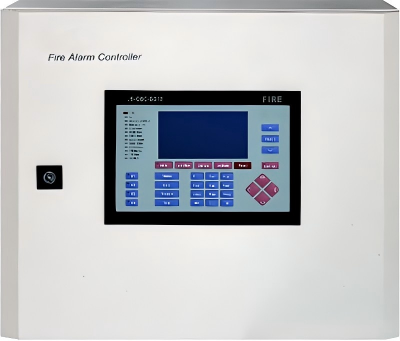
Fire Alarm Controller
The Fire Alarm Controller is usually installed on the navigation bridge, with repeater panels located in fire control stations.
This allows crew members to quickly identify the fire location. The fire alarm controller panel features a location indicator chart with illuminated indicators for each alarm zone. This enables the crew to promptly initiate fire-fighting procedures.
Sensors – How Detection Systems Work
Various sensors exist based on the area of application and method of detection. The principle for using fire detectors in different operational areas depends on one of four primary fire characteristics:
Smoke (Aerosol): Combustion always produces aerosols (tiny particles). This type of detector contains an ionization chamber to detect such suspended microscopic particles. Even for invisible products from complete combustion, detection can occur when the density of these suspended particles is sufficient.
Smoke (Visible): Visible smoke indicates a fire. Some detectors operate by detecting light obscured by smoke particles. Photosensitive devices can provide early fire warning.
Heat: The temperature rise caused by a fire's heat can be used for detection. Detectors may use a bimetallic strip to open or close an electrical circuit. One type uses exposed and shielded elements; the temperature difference between them generates an alarm signal.
Radiation: These detectors operate by sensing infrared or ultraviolet radiation emitted by a flame. They are suitable for areas where fires are expected to produce open flames immediately.
.png "Smoke Detector (2).png")
Smoke Detectors
Ionization Smoke Detector
Operating Principle:
This is a spot-type fire detector
. It is a point detector containing a small amount of radioactive material within a sensing chamber.
The radioactive material ionizes the air in the sensing chamber, making the air between two charged electrodes conductive, allowing a current to flow.
When smoke particles enter the ionized space, the introduction of impurities reduces the air's conductivity.
When conductivity drops to a predetermined level, the detector activates an alarm.
Photoelectric Smoke Detector (Beam Type):
This detector's principle involves a light source, a light beam alignment system, and a photosensitive element.
When smoke particles enter the light beam, they reduce the intensity of light reaching the photosensitive element, triggering an alarm.
This type of detection device is a beam type, used for covering large open areas.
Such a device has a light source at one end and a receiver at the other. An alarm is activated when smoke particles interrupt the light beam.
Photoelectric Smoke Detector (Scattered Light Principle)
Operating Principle:
This detector is typically a spot-type detector, operating on the principle of light scattering.
It consists of a light source and a photosensitive element, arranged so that under normal conditions, the light beam does not fall on the photosensitive element.
When smoke particles enter the light beam, they scatter the light onto the photosensitive element, triggering an alarm.
.png "Heat Detector(1).png")
Heat Detectors
Fixed Temperature Detector, Bimetallic Type
Operating Principle:
This detector uses two metals with different coefficients of expansion.
When these two metals are bonded together and heated, the metal with the higher expansion rate bends towards the side with the lower expansion rate.
Fixed Temperature Detector, Fusible Alloy Type
Operating Principle:
This detector operates based on the principle that certain metal alloys melt at relatively low temperatures. Typical melting temperatures range from 55°C to 180°C.
This detector consists of a fixed contact piece and a pair of contact springs held in place by a fusible alloy. Normally, the circuit is open, and no alarm is issued.
When the ambient air temperature reaches the melting point of the fusible alloy, the alloy melts. The contact springs are released, making contact with the fixed contact piece, closing the circuit, and generating an alarm. The operating temperature range for such detectors is typically 57°C to 102°C.
Fusible alloy detectors are non-restorable. This means that after activation, the fusible alloy element must be replaced. Although this is often a simple operation, it is crucial to remember that the detector is ineffective until the fusible alloy element is replaced after use.
Rate-of-Rise Detector (Bimetallic Type)
Operating Principle:
This detector uses two similar bimetallic strips, but one is shielded and protected to slow its rate of expansion.
When the ambient temperature rises rapidly, the exposed strip expands faster than the shielded strip, causing the electrical circuit to close and generating an alarm.
In some locations, minor temperature increases not caused by fire may occur. In such cases, due to the slow temperature rise, the exposed and shielded strips expand at similar rates, maintaining their relative distance and not triggering an alarm.
This characteristic means that a slow-burning fire, causing a gradual temperature increase, might not be detected. Therefore, this type of detector should be combined with a fixed temperature detector.
Rate-of-Rise Detector (Gas Expansion Type)
Operating Principle:
This detector, also known as a pneumatic detector, typically uses air as the gas within its chamber.
It consists of an air-filled chamber and a flexible diaphragm. When the air inside the chamber expands due to heat, the flexible diaphragm bulges upward, closing an electrical circuit and generating an alarm.
A small compensating vent on one side of the chamber provides the rate-of-rise function. This vent allows some air to escape and is calibrated to compensate for normal ambient temperature increases.
When the ambient temperature rises rapidly, the air in the chamber expands faster than it can escape through the compensating vent. The resulting pressure increase forces the flexible diaphragm upward, closing the circuit (adjustable via an adjusting screw) and triggering an alarm.
This characteristic means that a slow-burning fire, causing a gradual temperature increase, might not be detected. Therefore, this type of detector should be combined with a fixed temperature detector.
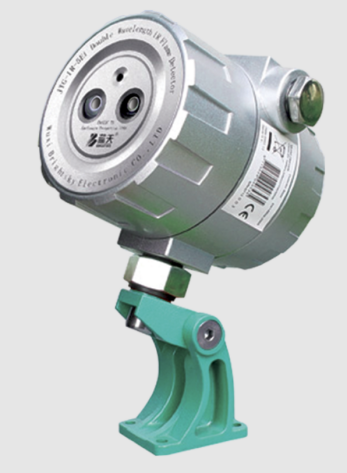
Flame Detectors
Operating Principle:
In addition to smoke and heat detectors, some areas utilize flame detectors for fire detection.
Flames consist of three components: visible light, infrared (IR) radiation, and ultraviolet (UV) radiation. As IR and UV radiation have specific frequencies (e.g., flame flicker frequency around 25 Hz), the detector's filter unit allows only IR or UV radiation to pass through and focus onto a photocell.
The signal generated by the photocell is processed by an amplifier and a time-delay circuit before being sent to the alarm unit. The time delay helps reduce false alarms caused by high-temperature objects or open flames like matches, boiler igniters, or torches.
Advantages:
Does not require combustion products to accumulate to the level needed for heat or smoke detector activation.
Particularly suitable for open areas.
Capable of very rapid fire detection.
Disadvantages:
Smoke can obscure the flame, reducing the detector's effectiveness.
The detector must detect visible flame before alarming; it does not respond to heat or smoke alone.
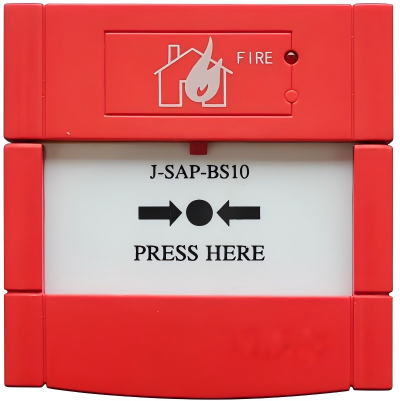
Manual Call Points
In addition to automatic fire detectors, an alarm can be triggered from manual call points located at various positions around the ship. Activation is typically achieved by breaking the protective glass cover and pressing the button.
Activating a manual call point produces a continuous or intermittently interrupted fire alarm bell sound. This alarm should also be integrated with the ship's general alarm system (sirens/horns).