
.jpg)
Impressed Current Cathodic Protection System (ICCP)
Hisea Marine's professional Impressed Current Cathodic Protection (ICCP) system provides long-term protection against hull corrosion by automatically monitoring and adjusting the current, serving as a replacement for traditional zinc anodes. It is suitable for various types of seafaring vessels and offshore platforms. Learn more about its working principles, core components, and advantages.
Overview
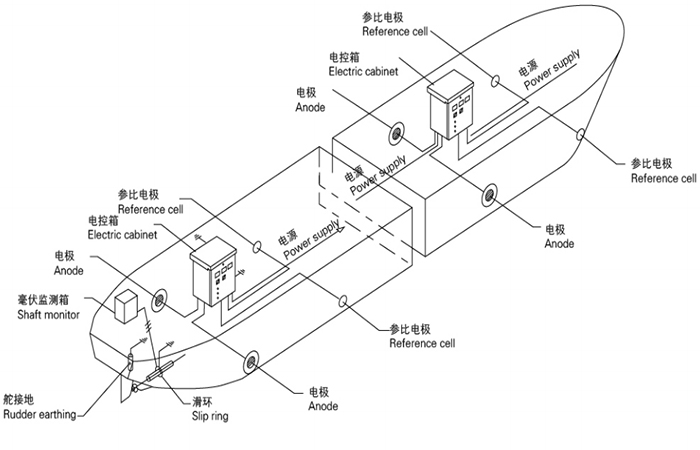
The impressed current cathodic protection (ICCP) system is used to protect the submerged parts of the ship's hull from seawater corrosion. The principle of operation is to continuously monitor the hull potential by means of a reference electrode mounted on the hull. If the hull potential exceeds the normal value (usually 220mV according to Classification Society specifications), the electronic control box will output a compensating current (direct current DC) to the titanium electrode. In this way the hull potential is always kept within normal values and corrosion does not occur.
Schematic Diagram of ICCP
The 3 Core Components of a Reliable ICCP System
Smart Control Panel:
Installed in the engine room, its core is the "Potentiostat," which automatically adjusts the DC output. Remote monitoring functionality is optional.
Titanium Anode Assembly:
Made with a titanium substrate and coated with Mixed Metal Oxide (MMO), it features a long lifespan (over 15 years) and high current efficiency.
Reference Electrode Assembly:
Used for precise potential measurement, serving as the "eyes" of the system's control mechanism.
Advantages Over Traditional Sacrificial Anodes
Ultra-Long Lifespan, Lower Costs:
With an anode lifespan of over 15 years, it eliminates the need for zinc anode replacement every 2-3 years, resulting in lower overall costs.
Automatic Adjustment, Optimal Protection:
Automatically adjusts current based on environmental factors (salinity, temperature, speed), ensuring consistently optimal protection.
Real-Time Monitoring, Easy Management:
Enables real-time monitoring of protection status, with optional remote monitoring, reducing the need for frequent manual diving inspections.
Environmentally Friendly:
Prevents the release of large amounts of zinc ions into seawater, making it more eco-friendly.
Minimal Added Weight:
Compared to tons of zinc anodes, it has minimal impact on vessel load capacity and stability.
Which Vessels Need an ICCP System?
Various Commercial Vessels: Tankers, bulk carriers, container ships, liquefied gas carriers, cruise ships, etc.
Offshore Structures: Mobile platforms, floating docks, FPSOs, etc.
Especially Suitable for: Newly built vessels, large vessels (over 150 meters), vessels with partially compromised coatings, and fleets pursuing the lowest long-term operational costs.
Picture of ICCP
1.jpg "Impressed Current Cathodic Protection System (ICCP)1.jpg")