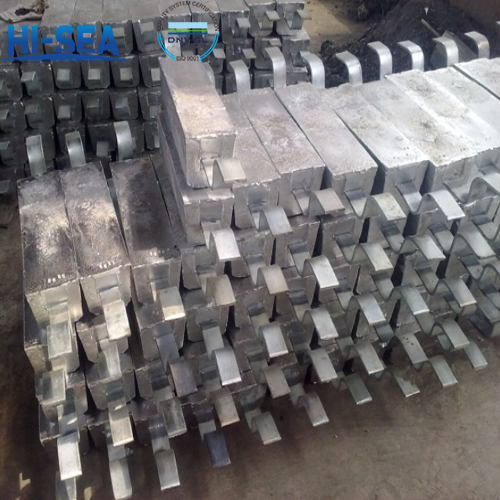
Sacrificial Anode for Aluminum Hull
Aluminium ships typically use aluminium anodes to protect the hull from corrosion. Aluminium anodes are a passive protection system that slows down the rate of corrosion on a ship's hull by exposing more corrosion-prone metals, such as aluminium, to seawater. Aluminium anodes are usually bolted or welded to the hull and are replaced periodically to ensure effective protection.
Overview
The use of aluminium alloy sacrificial anodes for aluminium ships is the best option.
Advantages
Aluminium alloy sacrificial anodes have a number of advantages that make them ideal for corrosion protection on aluminium ships.
1. Firstly, aluminium alloy has good corrosion resistance, utilizing the Al-Zn-In-X series alloy, which undergoes heat treatment, ensures stable performance in seawater environments and can withstand corrosive factors such as salt water, humidity and oxygen to protect the ship structure from corrosion.
2. Secondly, aluminium alloy sacrificial anode can absorb and disperse corrosive current, slow down the corrosion rate of metal structure and provide reliable protection.
3. In addition, the use of aluminium alloy sacrificial anode can reduce maintenance work and is environmentally friendly, in line with the requirements of sustainable development.
4. The installation and replacement of aluminium alloy sacrificial anode is relatively easy, and it can be installed flexibly according to the specific needs of the ship, and only need to check and replace the anode periodically without tedious maintenance work, which reduces the maintenance cost and workload maintenance cost and workload.
Avoiding Galvanic Corrosion & Over-Protection
Galvanic Series Principle:
In seawater environments, aluminum itself is relatively active. It is essential to use anode materials with a potential close to or slightly more negative than that of aluminum (such as specific aluminum alloy formulations or high-purity zinc) to provide adequate protection without inducing over-protection.
Over-Protection Risks:
Using anodes that are overly negative in potential (such as magnesium) can turn the aluminum hull into an excessive cathode. This intensifies the cathodic reaction (hydrogen evolution), leading to increased local pH levels. This, in turn, can cause alkaline corrosion of aluminum and result in coating blistering or detachment.
Choosing and Installing Anodes on Your Aluminum Boat
Recommended Alloy: Al-Zn-In-Sn.
Selection Factors:
Hull wetted area, navigation in seawater or freshwater, and the presence of coatings.
Installation Key Points:
Typically installed using bolted connections, ensuring clean metal contact between the anode and the hull. Anodes should be evenly distributed in key areas such as the stern, rudder, and bilge regions.
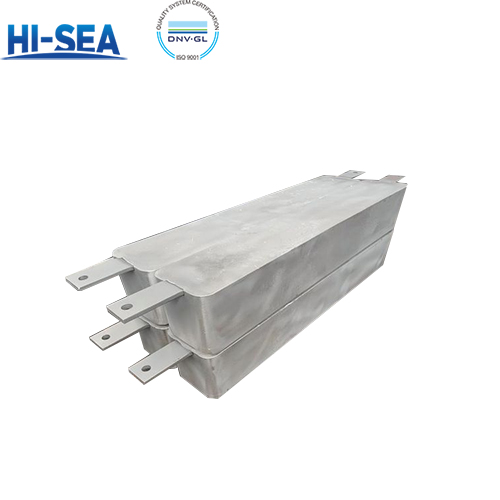
Picture of Sacrificial Anode for Aluminum Hull