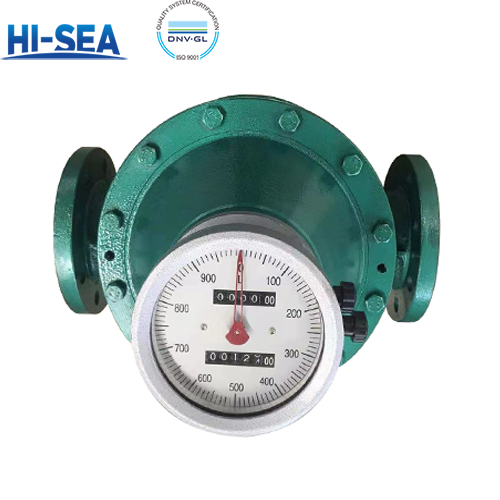
Oval Gear Flow Meter
An Oval Gear Flow Meter is a type of positive displacement (PD) flow meter. It is one of the most common and accurate technologies for measuring the volumetric flow rate of liquids.
Its key characteristic is that it measures the actual volume of liquid passing through the meter, making it highly accurate even with varying flow rates and fluid viscosities.
Overview
How Does It Work? The Basic Principle
The operation is mechanical and elegant, based on two meshing oval gears.
1. The Chamber: The fluid flows into a precisely machined chamber that houses two identical oval-shaped gears.
2. Meshing Gears: The gears are mounted on shafts and are in constant mesh with each other. The oval shape ensures they are always in contact at some point, sealing the inlet from the outlet.
3. Fluid as a Piston: As the fluid enters the meter, its pressure pushes the gears to rotate. The fluid is trapped in the pockets of space (the "chambers") between the gears and the outer wall.
4. Pocket Transport: With each rotation, a fixed and known volume of fluid is trapped and carried from the inlet side to the outlet side.
5. Counting the Cycles: The rotational speed of the gears is directly proportional to the flow rate. The shaft of one gear is connected to a magnetic coupling or a mechanical seal, which transmits the rotation to an electronic pickup (like a reed switch or Hall effect sensor) or a mechanical counter.
6. Output: The pickup counts the rotations or pulses. Since each rotation corresponds to a fixed volume, the totalizer can display the total volume that has passed through. By measuring the rate of these pulses, the flow rate is calculated.