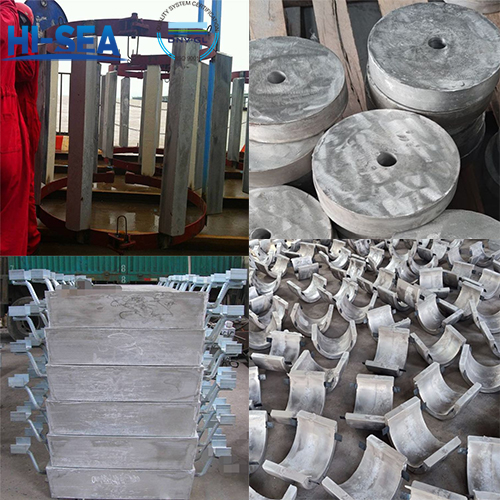
Aluminum Anode
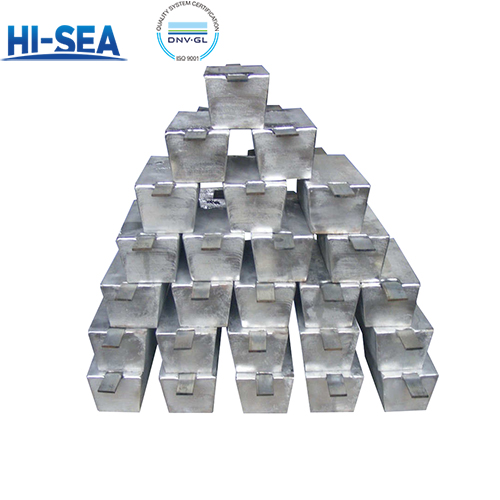
Aluminum anodes (typically made of aluminum-zinc-indium series alloys) provide protective current to structures by preferentially corroding and dissolving due to their more negative electrochemical potential compared to the protected metal. They feature a moderate driving potential, high current output, high power generation per unit weight, and a long lifespan. They are particularly suitable for environments such as seawater, brackish water, and soil containing chloride ions.
Overview
Application Fields of Aluminium Anode
Ships and marine engineering: aluminium anodes are widely used for anti-corrosion protection of ship hulls, propellers, offshore platforms, submarine pipelines and other facilities.
Storage Tanks and Containers: used for internal anti-corrosion of petroleum and chemical storage tanks as well as other containers for storing liquids.
Underground pipelines: such as cathodic protection of natural gas pipelines, oil pipelines, water pipes, etc.
Cooling water system of power plants: to prevent corrosion of cooling water pipes and equipment.
Precautions for Using Aluminium Anode
Selection of suitable alloy: according to the different use environment, select aluminium alloy containing appropriate amount of zinc, indium and other elements to improve the electrochemical performance of the anode.
Installation position: Ensure that the aluminium anode has a good electrical connection with the protected metal structure, and arrange the anode position reasonably to ensure the uniform distribution of protective current.
Regular maintenance: check the consumption of anode regularly and replace the exhausted anode in time to ensure the continuous anticorrosion protection of the system.
Why Choose Hisea Aluminum Anodes?
Optimized Alloy Formulation:
Utilizes precisely controlled Al-Zn-In alloy composition to ensure stable open-circuit potential, high current efficiency (typically >85%), uniform dissolution, and the absence of a passivation layer.
Strict Quality Control:
Full-process quality control from melting and casting to finished products ensures compliance with GB, ASTM, and other standards for chemical composition and metallurgical structure.
Diverse Specifications and Shapes:
Offers a variety of specifications, including block, plate, and strip anodes, as well as special-shaped anodes customized according to client drawings to meet installation needs for different structures.
Comprehensive Documentation Support:
Provides material certificates (MTC) and third-party inspection reports to facilitate project acceptance.
How to Choose the Right Sacrificial Anode Material?
Aluminum Anodes:
Most suitable for seawater and brackish water environments. With moderate driving potential, high capacity, and long lifespan, they are the most commonly chosen option for ships and offshore structures.
Zinc Anodes:
Suitable for low-resistivity seawater environments, offering stable driving potential, but with lower power generation per unit weight compared to aluminum anodes.
Magnesium Anodes:
Suitable for high-resistivity freshwater, soil, or low-salinity water environments. They have the highest driving potential but exhibit fast consumption and a short lifespan.
Conclusion:
For the majority of marine applications, aluminum anodes provide the best balance of performance and cost.
Picture of Alumminum Anode