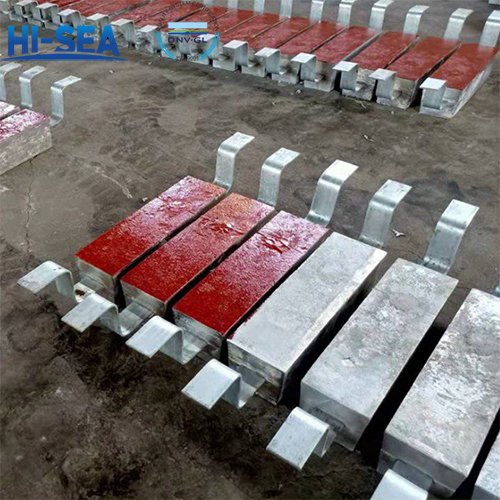
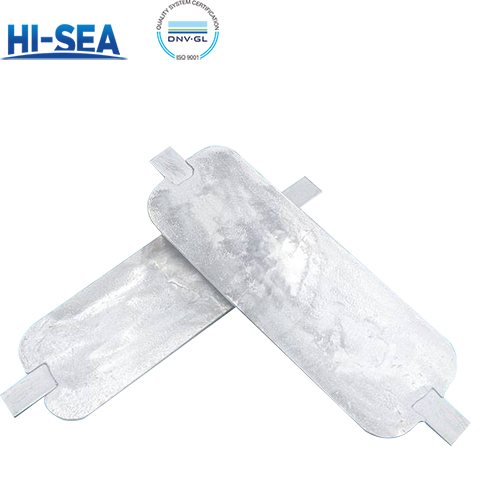
Aluminum Alloy Sacrificial Anode
Commonly used aluminium alloy sacrificial anode specifications are 16kg, 22kg, 23kg, 33kg, 35kg, 50kg, 85kg, 120kg, 131kg, 180kg, etc.
Note: We can also manufacture anodes with special specifications and chemical compositions according to customers' requirements.
Overview
This product is a high-performance aluminum alloy sacrificial anode, serving as a core consumable component in electrochemical cathodic protection (CP) systems for vessels, offshore structures, and industrial equipment. With a more negative electrode potential than the protected metal (such as steel), it preferentially corrodes and dissolves in electrolytes (e.g., seawater), thereby continuously supplying electrons to the protected structure. This induces cathodic polarization, fundamentally inhibiting corrosion.
II. Key Electrochemical Properties and Working Environment Details
Standard Electrode Potential: The standard working potential of aluminum sacrificial anodes relative to a reference electrode is -1.05 volts. This stable potential is the basis for their ability to effectively protect metals like steel in the galvanic series.
Effect of Temperature on Performance—Key Formula: The capacity (or effective output) of aluminum anodes decreases as the working environment temperature rises. This relationship can be estimated using a validated formula:
Z = 2500 - 27 × (T - 20)
- Z represents the current capacity of the anode, in ampere-hours per kilogram (Ah/kg). The value calculated by the formula is the theoretical capacity at a specific temperature.
- T represents the actual working temperature of the anode, in degrees Celsius (°C).
Interpretation: The formula shows that at the baseline temperature of 20°C, the theoretical capacity of the anode is approximately 2500 Ah/kg. For every 1°C increase in temperature, the capacity decreases by about 27 Ah/kg. Therefore, when designing a system, especially in high-temperature environments (such as tropical waters or certain industrial processes), this reduction must be taken into account to ensure the protection effectiveness over the design lifespan.
Environmental Suitability and Key Limitations:
- Ideal Application Areas: Aluminum anodes are widely used in seawater and are the preferred choice for protecting ships, mechanical equipment, marine engineering structures, seaports, and wharves, as well as subsea pipelines and cables. They are also commonly used for the internal protection of crude oil storage tank bottoms.
- Key Environmental Warnings:
- Reduced Performance in Brackish Water: In brackish or low-chloride semi-saline water environments, the current capacity of aluminum anodes can be reduced by up to 50%. This means that in estuaries or areas with fluctuating salinity, the anode quantity must be recalculated, or alternative materials should be considered.
- Unsuitability for Soil Environments: Aluminum anodes are not suitable for low-chloride soil environments. In typical terrestrial soils, their surface is highly prone to passivation, preventing effective dissolution and the output of protective current. Thus, they should never be used for conventional cathodic protection of buried pipelines.
III. Installation and Application Advantages
Ease of Installation: Aluminum sacrificial anodes are designed to be directly fixed to the structure of the protected equipment (e.g., by welding iron cores or using bolts, clamps, etc.). They typically do not require backfill materials like coke as a fill bed, which simplifies the construction process, especially in space-constrained or underwater installations.
Cost-Effectiveness and Long Service Life: Compared to traditional zinc sacrificial anodes, high-quality aluminum alloys (typically from the Al-Zn-In series) have higher electrochemical capacity and a more uniform consumption rate. This means that, for the same total protective current, aluminum anodes are lighter, more compact, and have a longer service life (usually 2-3 times that of zinc anodes), significantly reducing replacement frequency and overall maintenance costs over their lifecycle.
Environmental Friendliness: Compared to some traditional materials, the dissolution products of modern environmentally friendly aluminum alloy anodes have a smaller impact on the environment.
IV. Product Selection and Technical Support
Selecting the correct anode type and quantity is a professional engineering calculation process that depends on:
- The material and total surface area of the structure to be protected.
- The resistivity, temperature, flow rate, and chemical composition (especially chloride ion concentration) of the environmental medium.
- The required design protection lifespan.
- The condition of the existing anti-corrosion coating.
Picture of Aluminum Alloy Sacrificial Anode