
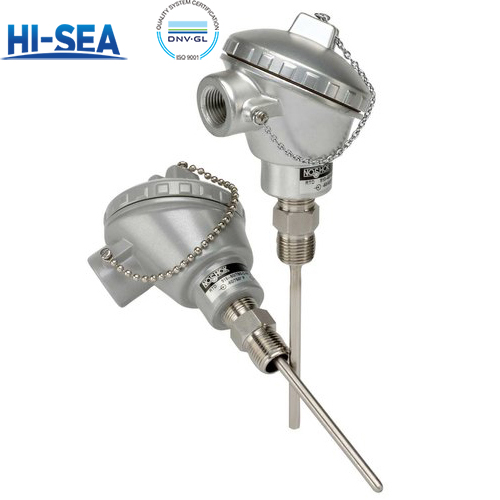
4-20 mA Temperature Transmitter
A 4-20 mA Temperature Transmitter is a device that converts the physical signal from a temperature sensor (like an RTD or thermocouple) into a standardized, proportional 4-20 milliamp DC electrical signal. This signal is then sent to a controller, recorder, or PLC (Programmable Logic Controller) in a control system.
Overview
Configuration and Ranging
Modern "smart" transmitters are highly configurable. Key parameters include:
• Sensor Type: You must configure the transmitter to match the sensor (e.g., Pt100 RTD, Type K Thermocouple).
• Range (LRV and URV): You set the Lower Range Value and Upper Range Value.
◦ Example: A transmitter with a Pt100 sensor can be configured so that:
■ 4 mA = 50°C (LRV)
■ 20 mA = 250°C (URV)
◦ A reading of 12 mA (the midpoint) would represent 150°C.
• Linearization: The transmitter converts the non-linear response of RTDs and T/Cs into a perfectly linear 4-20 mA signal.
• Diagnostics: Smart transmitters can detect sensor burnout, out-of-range conditions, and hardware failures.
Example: Calculating Temperature from a Current Reading
Let's use the range from above: 50°C to 250°C.
• Span (Temperature): 250°C - 50°C = 200°C
• Span (Current): 20 mA - 4 mA = 16 mA
If you measure a 13.6 mA signal on the loop:
1. Find the current above the "live zero": 13.6 mA - 4.0 mA = 9.6 mA
2. Calculate the percentage of the span: (9.6 mA / 16 mA) = 0.6 (or 60%)
3. Apply this to the temperature span: 0.6 * 200°C = 120°C
4. Add the LRV: 120°C + 50°C = 170°C
Therefore, a 13.6 mA signal corresponds to a temperature of 170°C.